
We may earn money or products from the companies mentioned in this post.
Small studies of red light therapy for dogs with arthritis found that specific veterinary laser treatments improved some measures of pain or mobility. Those studies didn’t test the consumer LED wraps, wands, or panels you can buy for home use. If you’re shopping for one, ask your vet whether the exact device makes sense for your dog’s diagnosis before spending money.
If you use a panel on yourself and your dog happens to be nearby, see our guide to pets sharing the room during red light therapy.
Table of Contents
Affiliate disclosure: As an Amazon Associate I earn from qualifying purchases.

What is red light therapy for dogs?
Red and near-infrared light treatments are often grouped under photobiomodulation, or PBM. A veterinary clinic may deliver PBM with a therapeutic laser aimed at a specific joint. At-home devices can use LEDs or lasers, depending on the model. The label “red light therapy” tells you very little about how much light reaches the treatment area or whether the device has been studied for your dog’s condition. Veterinary laser overview
Does red light therapy help dogs with arthritis?
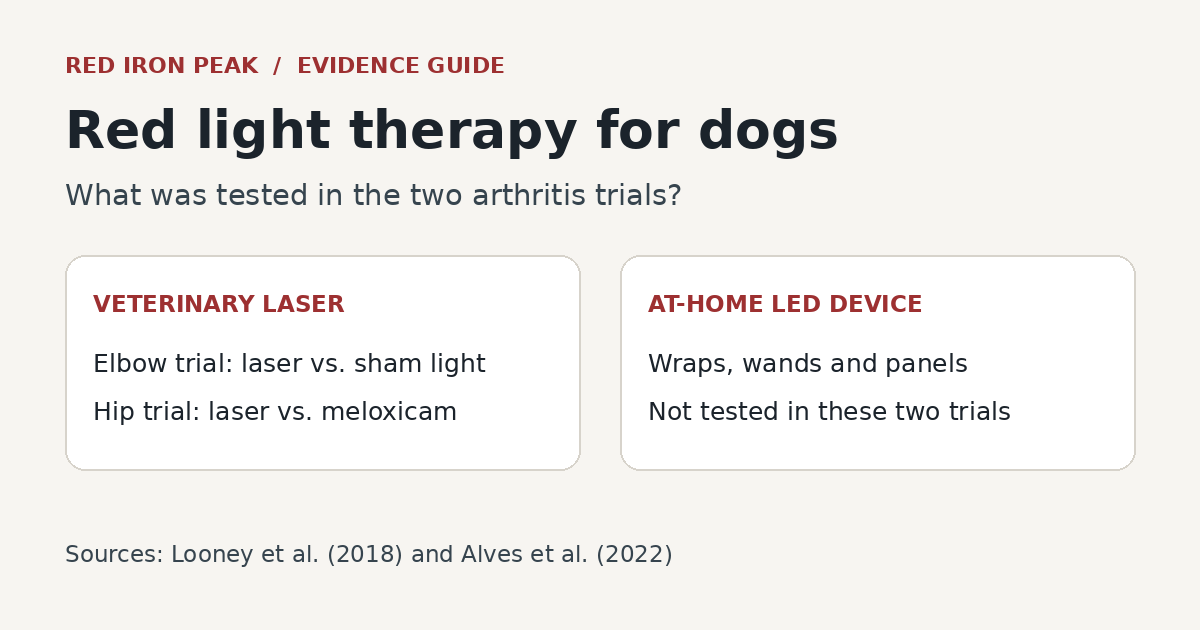
Two small controlled trials offer a reason to ask a veterinarian about laser therapy for a dog with diagnosed osteoarthritis. They also show why a product page needs to tell you more than “backed by science.”
| Study | What researchers tested | What they found | Where the evidence stops |
|---|---|---|---|
| Elbow arthritis, Looney et al. (2018) | 20 dogs assigned to a veterinary laser or a sham treatment for six weeks | The laser group improved more on lameness and several pain measures. Under the study protocol, anti-inflammatory medication was reduced in 9 of 11 treated dogs and 0 of 9 sham-treated dogs. | A small, short trial of one laser protocol for elbow arthritis. Medication changes were part of the study, under clinical supervision. |
| Hip arthritis, Alves et al. (2022) | 20 dogs with arthritis in both hips. A class IV veterinary laser course was compared with meloxicam. | Some pain and function scores favored the laser at early follow-ups. | This was a small comparison against a medication. It didn’t test a home LED device. |
The studies measured symptoms and function. They didn’t show that light rebuilt cartilage or reversed arthritis. A 2023 systematic review of veterinary light therapy found wide variation in treatment protocols and concluded that the available research gave limited support for many veterinary uses. For a dog with arthritis, the useful takeaway is that a specific clinic protocol may help some dogs, with the vet deciding how it fits into the overall care plan.
Red light therapy for dogs at home: How to check a device claim
One example is the LumaSoothe 2 on Amazon, a handheld pet LED marketed for joint support. The manufacturer lists five wavelengths across two modes. Look for the study behind the specific claim. A wavelength list describes what the device emits. To judge the claim, check whether the study tested the same model, used it on dogs with the same diagnosis, and measured pain or mobility. The elbow and hip trials above tested veterinary lasers.
Here’s what I’d look for before giving a product’s “clinically studied” claim any weight:
| What to ask for | Why it matters |
|---|---|
| The actual study link | Look for a paper on the exact device in dogs with the same diagnosis. A study on humans, a skin wound, or a different laser answers a different question. |
| Light source and measured output at the stated distance | Wavelength tells you the kind of light. Output and treatment distance help describe how much light reaches the surface. A matching wavelength alone can’t establish the same exposure at the joint. |
| Where and how it was used | A laser applied to a specific elbow in a trial and a wrap laid over a furry hip are different setups. Ask your vet how placement, coat, and the joint being treated affect the comparison. |
| Device-specific safety instructions | Ask how to protect eyes and what to do if your dog won’t stay still. Veterinary guidance calls for appropriate eye protection with higher-powered therapeutic lasers. Veterinary laser safety |
If the seller gives you a study on a different device, you can still ask your vet about the product. Treat the claimed benefit as unverified for that model unless the seller can show evidence that applies.
What to ask your vet before spending money
- What’s causing my dog’s stiffness or limp? Get the diagnosis first, especially if the change is new.
- Would clinic laser therapy be a reasonable add-on? Ask which joint they’d treat, what the proposed course would cost, and when they’d reassess it.
- Would you consider this exact home device? Bring the model, manual, and any study the seller cites. Ask what safety precautions apply.
- What would count as improvement? Pick two things you already see at home, like getting up after a nap or finishing the usual walk. Ask the vet how long to track them and when to stop or reassess.
If your dog already takes pain medication, keep medication decisions with the prescribing vet. A trial that included supervised medication reductions doesn’t provide a plan for changing your dog’s prescription.
What the elbow and hip studies can tell your vet
The elbow and hip trials answer different questions. The elbow study compared a veterinary laser protocol with sham light. That design helps separate an effect of the light from what might happen when both groups receive similar attention and follow-up. The investigators evaluated specific measures after a six-week course. The result is relevant to the protocol and the dogs enrolled, with a small sample and a short follow-up.
The hip trial compared a course of Class IV laser treatments with meloxicam in dogs with arthritis in both hips. Its comparison group received an active treatment. That gives a different point of comparison from sham light, and neither the device nor the schedule is interchangeable with the one used in the elbow trial. The result is a reason to discuss clinic laser therapy with a veterinarian who knows your dog’s case. It does not establish that owners should replace medication or buy a home LED.
When you see a favorable pain or mobility score, ask what changed in practical terms. Was it a score for pain interfering with daily activities, a gait assessment, or a range-of-motion measurement? A difference in one measure can be useful without establishing the same result on every measure. It also does not tell you whether an individual dog will have an improvement you can see in its ordinary routine. Bring the specific daily problem you want to address to the appointment.
Keep a product claim separate from the result in the paper. If a seller cites the elbow study next to a device designed to wrap a hip, there are at least three questions to ask about applicability. Was the same joint treated? Was the same device used? Were the outcomes and the time of assessment similar to what you want to achieve? Start with the linked elbow trial and hip trial when a product page summarizes either one.
How to compare the device in your cart with a study
Take a screenshot of the exact listing and download the manual, if it is available. Include the model and any variant name. Listings sometimes group several devices under a single name or update the photos without changing the listing address. If the seller replies with a study or a manual for a product family, ask which document applies to the version you would receive.
Look for a named light source and output information that describes the mode in question. A wavelength is commonly listed in nanometers. An irradiance figure describes power arriving per unit area under stated conditions. A timer gives the length of a preset. Each tells you something different. Even a matching wavelength and timer cannot establish that the home LED reproduces the exposure or results of a clinic laser. Our red and infrared light guide explains how to read those specifications.
Read the manual with the practical setup in mind. A handheld device needs to be held in position. A wrap has to fit where the vet thinks it would be used. A panel needs a way to stay stable and may illuminate a larger area. Check which of those descriptions matches your home and what the manufacturer actually documents. Bring the manual to the vet and ask whether the instructions and precautions are suitable for your particular dog.
If the seller gives you an output figure, ask what mode, distance and measurement location produced it. A single figure from the center of an emitter cannot describe a whole treatment area. If the answers are missing, mark the output as unknown in your notes. Do not calculate a home dose from the numbers in a veterinary study or copy a clinic’s settings onto a different device.
A useful seller reply gives you a paper title or a link you can open, identifies the tested device, and explains which claim the paper supports. If the answer is simply that red light is widely studied, you still have a question about the exact product. Save the response so your vet can review the underlying evidence instead of relying on the sales summary.
Compare the cost of an at-home device with clinic visits
Ask your clinic to quote an initial course and tell you when it would reassess your dog. Check what that price includes. An examination, a follow-up appointment and laser sessions may be billed separately. If the clinic offers a package, ask what happens to the unused visits if the vet decides to stop or change course. Travel and time away from work can matter alongside the invoice.
For a home device, write down the delivered price and check whether the seller takes returns after the package has been opened. Confirm whether the return deadline starts on the order date or at delivery, who pays return shipping, and whether the refund depends on original packaging. Keep return terms separate from the warranty. A warranty addresses covered faults. It does not necessarily give you a way to return a working device if the vet advises against using it.
Here is a hypothetical comparison. A clinic quotes $240 for the sessions before the first reassessment. A home device costs $180 delivered, with a $20 return shipping charge if opened returns are allowed. The home device has a lower purchase price in that example, but the comparison depends on whether the vet thinks there is a reason to use it in the first place. If the model is unsuitable or its benefit is too uncertain for your dog’s case, the cheaper price still buys something you may never use.
Decide what you would do if the first option fails to help. With the clinic, ask whether the vet would reassess the original diagnosis or adjust another part of the care plan. For a home device, find out whether the planned reassessment falls within the seller’s return period. Those deadlines serve different purposes. Agree on the clinical decision with the vet before committing to a purchase or a block of sessions.
Track ordinary movement before the follow-up
Ask the vet what would count as a meaningful change for your dog. Getting up from a usual resting spot, walking to the gate, or comfortably joining the same short routine are more concrete observations than a general impression that the dog seems younger. Choose activities your dog already does. There is no need to set up a harder test or ask your dog to do something painful to get a comparison.
Write down what those activities look like before anything changes. If the veterinarian wants video, record a short clip during a normal routine. For example, describe whether the dog got up at once, paused, or needed help. During follow-up, use similar conditions when possible. The notes are for discussion with your vet, and there is no universal score you have to assign yourself.
It helps to record context beside the observation. A long walk the previous day, a different floor surface, or another change your vet made to the care plan can affect what you see. Write down better and worse days so the conversation does not rest on a single unusually good morning. A comparison across several ordinary days is easier to discuss than a memory of how the dog seemed at checkout.
The AAHA guidelines on assessing chronic pain in dogs discuss owner questionnaires such as the Canine Brief Pain Inventory and the Liverpool Osteoarthritis in Dogs questionnaire. Ask whether your clinic uses one of them or prefers a small set of activities tailored to your dog. The clinic can explain how it interprets the answers alongside an exam.
At the follow-up, bring the notes, the dates of any changes the veterinarian made, and the questions you still have. You can ask whether any difference is large enough to justify continuing, what to do if the changes are inconsistent, and when the clinic wants another update. Keep medication and treatment decisions with the vet, even if your notes show an encouraging change.

Four buying mistakes to avoid
Buying for a symptom before identifying its cause. If a dog is struggling to stand, ask what the vet thinks is causing that change. Knowing the joint or condition under discussion makes it easier to tell whether a study applies. It also helps you explain what you hoped a device would change.
Treating the seller’s study as a product test. Check the model and the study group before relying on a “clinically studied” label. If the study and device differ, write down exactly where they differ so you can ask the vet a specific question.
Comparing the checkout price alone. Consider the full clinic quote and the cost of returning an opened home device. Ask whether you can review the manual before opening the package.
Skipping the reassessment plan. Decide with your vet what change you would look for and when you would check in. If there is no clear answer on how you would tell whether it helped, hold off on buying until you have one.
Frequently asked questions
Can I use my human red light panel on my dog?
Ask your vet to review the exact panel before using it. The canine arthritis trials above used targeted veterinary lasers, so they don’t establish a safe or effective distance, exposure time, or dose for a human panel used on a dog.
Is a pet LED wrap the same as cold laser therapy?
A wrap can use LEDs, while cold laser therapy uses a laser. Check the manual for the actual light source. Whether the device is appropriate depends on the diagnosis, output, placement, and the evidence for that use.
How long does it take to see a difference?
The elbow study assessed dogs after a six-week course, while the hip study measured outcomes at several follow-ups. Those schedules describe the studies. If your vet recommends trying a device, agree on a reassessment date and what change you expect to see. Elbow trial · Hip trial
How we researched this: Red Iron Peak compared published canine studies, veterinary safety guidance, and manufacturer documentation. Read more about Red Iron Peak. We did not test devices on dogs. This guide is for research and shopping decisions. Your veterinarian can advise on diagnosis and treatment.